Key Takeaways
- Substitution drawback can refund duties even when your imported goods were sold or used up in the U.S.
As long as goods with the same 8-digit HTS code are exported. - Substitution claims require far fewer linked records.
You don’t have to trace the same physical items from import to export, and the exported goods don’t have to be imported at all. - You don’t have to be both the importer and the exporter.
A customer, vendor, or other company in your supply chain may hold the other half of the claim. - A few rules determine whether a claim works and what it’s worth.
That includes the five-year window and which duties, like the new Section 301s, qualify. - You can check your own eligibility using your import and export data.
Start by comparing the tariff codes on your import and export reports.
When I ask trade compliance specialists whether their company has looked into duty drawback, I usually hear some version of the same answer: “We don’t export much, and everything else gets used here anyway.”
Oftentimes, this assumption turns out to be wrong, resulting in millions of dollars going unclaimed.
Why? The reason isn’t the famously arcane regulations from Customs and Border Protection (CBP). Instead, the opportunity is often hiding right there in the company’s own data.
A quick refresher on drawback
Duty drawback is a refund of up to 99% of the duties, taxes, and fees paid on imported goods that are later exported in the same form or manufactured into something else. Importers, exporters, and intermediaries can file claims.
When duty rates were low, many companies didn’t bother with drawback. That math has changed. Earlier this year, new Section 301 tariffs imposed duties of 10% to 12.5% on goods from 60 economies. That’s on top of existing levies. Goods from China, for example, are now tariffed around 36.5% on average.
The good news: CBP has confirmed the new Section 301 tariffs are drawback eligible.
The type of drawback that best answers “everything gets used here” is called substitution. You don’t have to prove that the goods you exported are the same physical items you imported. You only have to show that they match on paper. This blog post will show you how substitution drawback works, why it’s the simplest type of drawback to file, which rules to know, and how to check your own data.
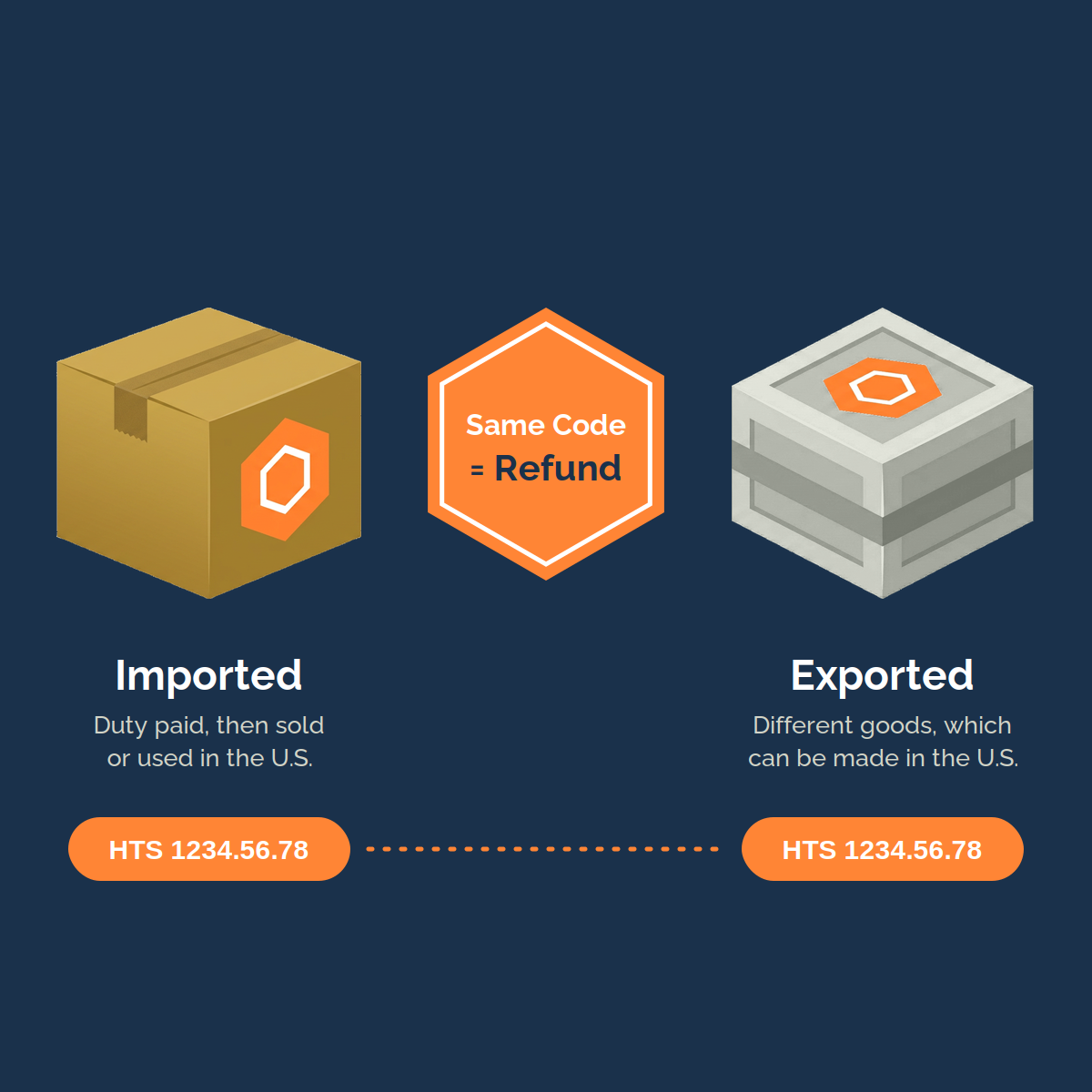
Up to 99% of the duty paid can be refunded. The goods don’t have to be the same, only the HTS code.
What is substitution drawback?
Substitution drawback refunds duties on imported goods when you export goods that are classified the same way, even if they aren’t the same physical items.
It helps to compare it with its opposite, direct identification. Under direct identification, you track the exact imported items all the way to export. If you import parts and build them into a machine, you have to prove that those specific parts ended up in the machine you shipped.
Substitution drops that requirement. You show that you imported goods under a given tariff classification and paid duty on them. Then you show that other goods—any goods under the same classification—were exported. What happened to the original imports doesn’t matter. They may have been sold or used up long ago.
Substitution comes in two main forms:
- Unused merchandise substitution. You import duty-paid goods, then export matching goods that haven’t been used in the U.S. The exported goods are often domestically made or purchased.
- Manufacturing substitution. You import duty-paid materials, then export a finished product made with matching materials, whether those materials were imported or domestic.
Why it’s the easiest type of drawback to file
The biggest advantage is recordkeeping. A direct identification claim needs a chain of records that follows the same items from import to export, such as inventory, transfer, and production records.
A basic substitution claim connects two things: an import record showing what came in and what duty was paid, and an export record showing goods with the same tariff code went out. There are still records to keep, but far fewer links to prove.
The simplest case is a company that both imports and exports goods under the same 8-digit Harmonized Tariff Schedule (HTS) code. Its own records show both sides of the claim. Matching is by code, not part number.
It wasn’t always this simple. Before the Trade Facilitation and Trade Enforcement Act (TFTEA), companies often needed a CBP ruling that their goods were interchangeable, and matches could come down to identical part numbers. Since TFTEA’s drawback provisions took effect in 2018, goods qualify if they share the same 8-digit HTS code, as outlined in 19 CFR 190.22. If your company looked at drawback years ago and ruled it out, it may be worth a second look.
Whether goods match depends on their HTS code, not on how you or your customers describe them. Before deciding your products are too specialized for drawback, look at how they’re classified. You may find more matches than you expect.
You don’t have to be the importer or the exporter
One of the most common reasons companies rule out drawback is the belief that only the importer of record or the exporter of record can file. That isn’t the case. The claimant can be the importer, the exporter, or another party in the supply chain. In fact, multi-party claims are common. In my experience, at least half the drawback claims I’ve filed over the years involve more than one company.
Here’s an easy-to-follow example. Imagine a distributor that imports 1,000 cases of a product and pays duty. It exports 100 cases itself, which is a straightforward claim. The other 900 cases go to domestic customers, and the distributor assumes they’re used up in the U.S.
That may be true. But substitution doesn’t care where the imported cases went. What matters is whether a customer, or another company in the supply chain, exports goods under the same 8-digit code. Those exports can be domestic goods, shipped as-is or built into a finished product. If they match, there may be drawback available on duties the distributor paid.
This is the part most companies miss. The importer isn’t watching what its customers export, and the exporter doesn’t know the importer paid duty. Neither side is focused on drawback, so the refund goes unclaimed.
It works from the other direction, too. Picture a retailer that exports some of its merchandise but buys it from vendors who are the importers of record. The retailer didn’t pay the duties directly, so it assumes there’s nothing to claim. But the vendors can pass their drawback rights to the retailer, along with the import records that support them, so a claim can be filed on those exports.
Making a multi-party claim work
Today, CBP accepts ordinary business records (e.g., purchase orders or invoices) to show how goods moved between companies.
Multi-party claims raise some concerns. Importers usually don’t want customers to see their costs or suppliers. Exporters may not want vendors to know they’re receiving refunds. There’s also liability to consider because the importer and the drawback claimant are jointly and severally liable if a claim has to be repaid. In plain terms, CBP can recover the full amount from either company, regardless of any private agreement between them.
Companies can coordinate a multi-party claim on their own, and some do. It gets harder when you represent only one of the parties. That’s where a drawback broker often makes sense. A broker can sit between the companies, put nondisclosure agreements in place, keep each company’s data separate, and submit only what CBP needs.
If you suspect your customers or vendors export under the same codes you import, it’s worth speaking to a drawback expert to see whether the proverbial juice would be worth the squeeze. And at today’s tariff rates, it often is!
Four rules to know
These four rules decide whether a claim works and how much it’s worth.
1. The five-year window
The five-year statute of limitations starts on the date of importation (19 U.S.C. § 1313(r)(1)). Exports must happen, and claims must be filed, within five years of that date. Every month that passes, a month of older imports ages out.
2. Not every duty qualifies
Antidumping and countervailing duties (AD/CVD) are never eligible for drawback. Section 232 duties vary by product, because each proclamation sets its own drawback terms. Section 301 duties are eligible, including the newest round that went into effect in July 2026. Other tariffs have their own wrinkles, too. Exports to Canada and Mexico also have their own limits under the USMCA, and substitution often isn’t available for those shipments. Check how the specific duties you pay are treated before you estimate a refund.
3. The “other other” rule
Common products usually have their own 8-digit HTS code. A toaster oven, for example, has a specific code. Less common products often land in catch-all codes whose descriptions begin with “Other.” CBP doesn’t allow 8-digit matching on these, because they can group very different products together.
Instead, you move to the 10-digit level. If the 10-digit description is specific, you can substitute at that level. If the 10-digit description also begins with “Other,” the goods can’t be substituted. Practitioners call this the “other other” rule.
This is one reason accurate classification matters. A product placed in a catch-all code for convenience may lose its drawback eligibility.
4. The “lesser of” rule
Because substituted goods aren’t the same physical items, CBP caps the refund. You can recover 99% of the lesser of two amounts: A) the duty paid on the imported goods, or B) the duty that would have applied to the exported goods if they had been imported. For manufacturing substitution, the comparison uses the materials that went into the exported product, not the finished product itself. This prevents a company from paying duty on an expensive item and claiming it against a much cheaper export.
Here’s a simple example. You import a product valued at $10 and pay 20% duty, or $2. You export a matching product valued at $5. Had it been imported, the duty would have been $1. Your refund is 99% of the $1 figure, or 99 cents, not 99% of the $2 you paid.
The foreign country’s duty rate doesn’t enter into it. The comparison uses U.S. duty only.
A self-check you can do now
You don’t need to become a customs expert to find out whether substitution drawback is worth pursuing. These steps take little more than an afternoon.
- Obtain two reports. For imports, ask your customs broker for the ES-003 entry summary report. For exports, you’ll need the 202 export report, which shows the export filings made under your company’s name. Go back five years for each. When I start working with a new company, these are the first two reports I ask for.
- Consider your own ACE account. If you use more than one customs broker, a single broker can only see the entries it filed. Your own account in ACE, CBP’s trade portal, shows all of your import data in one place. It’s a federal government system, and it feels like one, but it’s worth having for ongoing visibility.
- Look for matching 8-digit codes. Compare the HTS codes on your import report with those on your export report. A match within five years is your simplest potential claim. Watch for codes whose descriptions begin with “Other.”
- If you manufacture, check your bill of materials. ACE won’t show which imported materials went into an exported product. That information lives in your ERP or production system.
- Ask your customers and vendors. If you sell imported goods domestically, find out whether your customers export anything under the same codes, either as-is or inside finished products. If you export goods that your vendors imported, ask whether they’ll share their import records.
- Make it a habit. Review these reports monthly. It’s the simplest way to understand what you’re paying and to spot changes early.
What you take on when you file
Drawback is a refund from the federal government, so it comes with some responsibilities. None of them should be unfamiliar to a company that has import or export activity.
A common worry is that filing for drawback puts a target on your company. In my experience, it doesn’t. CBP reviews drawback claims as a routine part of processing them, and that’s different from scrutinizing the rest of your import activity. A well-documented claim is easy to support.
- Routine questions. CBP may ask about a claim, most often through an informal desk review such as a request for a signed export bill of lading. These are a normal part of the process, and a well-prepared claim makes them quick to answer.
- Record retention. Keep the records supporting each claim for three years after the claim is liquidated.
- Consistent data. When the same products are classified the same way and their origin is documented accurately, claims match cleanly and questions are simple to answer. That’s good import practice with or without drawback.
Where to start
Substitution is the most forgiving type of drawback to file. The imported goods can be used up here, the exported goods can be domestic, and you may qualify even if you’re not the company that imports or exports them.
My advice is to start with your own data, using the self-check above.
If you’d like a second set of eyes, or help coordinating a claim across companies, that’s the work my colleagues and I do every day. Let us know if we can help.
Frequently Asked Questions
Yes. The claimant can be the importer, the exporter, or another party in the supply chain. If you export goods that a vendor imported, the vendor can pass its drawback rights to you along with the records that support the claim.
Often, yes. Under substitution, what happened to the imported goods doesn’t matter. What matters is whether goods with the same 8-digit HTS code were exported within five years of the import date, whether by you or by someone else in your supply chain.
Five years from the date of importation. Both the export and the claim must happen within that window (19 U.S.C. § 1313(r)(1)). The oldest entries age out first, so it pays to look sooner.
Up to 99% of the lesser of two amounts: the duty paid on the imported goods, or the duty that would have applied to the exported goods if they had been imported (19 CFR 190.32).
Yes. CBP confirmed in August 2026 that the Section 301 duties that took effect July 24, 2026, are drawback eligible (CSMS #69567203). Antidumping and countervailing duties are never eligible, and Section 232 eligibility varies by product.
No. CBP reviews drawback claims as a routine part of processing them, often with an informal request for documents such as a signed export bill of lading. That’s separate from scrutinizing the rest of your import activity, and a well-documented claim is easy to support.