Key Takeaways
- A tariff is a fee collected on goods imported into a country or economic zone, usually imposed to shield domestic producers.
- Section 301 sits in the Trade Act of 1974 and targets another country’s unreasonable or burdensome trade practices, using retaliation as the lever.
- Section 232 sits in the Trade Expansion Act of 1962 and targets imports that create a national security risk, protecting domestic production capacity.
- Both statutes went largely unused for decades as global free trade expanded, then were revived from 2018 onward.
- The 2018 Section 301 action rolled out in tranches, with an exclusion request process attached to the early rounds.
- The original Section 232 action set 25% on steel and 10% on aluminum.
- Added duties in the 10% to 25% range move enough cost that drawback shifts from optional to necessary for import-heavy operations.
With all the discussion about tariffs these days it is necessary to pay closer attention to what it all means. Let’s begin with the basics. A tariff is essentially a fee collected on a particular good imported into a country or economic zone, such as the European Union. The tariffs we want to take a closer look at today though, are the Chinese Tariffs and those duties falling under 301 and 232.
Tariffs are usually imposed to protect domestic producers. The Trump Administration has been adamant from its inception about preserving US manufacturers by limiting certain imports into the United States. According to President Trump, faulty trade deals have caused the loss of America’s manufacturing prowess, which is rapidly becoming a nostalgic recollection and also diminishing America’s power to protect our National Security when needs come into play.
President Trump has had the Office of the United States Trade Representative dust off a couple of old laws which have not been applied practically for a few decades. Namely, the Trade Expansion Act of 1962, and the Trade Act of 1974. The reason for the inactivity of these laws has been the expansion of global free trade, and the subsequent abolition of tariffs.
As a pillar of his “Make America Great Again” campaign, President Trump has evoked his right, as president, to use both the Trade Expansion Act of 1962 and the Trade Act of 1974 to advance his America first agenda. Notably, he has deployed Section 301 of the 1974 law, and Section 232 of the 1962 act. Thus, we have our section 301 tariffs and our section 232 tariffs.
The Section 301 tariffs: These give the U.S. President the ability to implement initiatives to counteract burdensome or unreasonable actions of another country which may negatively impact American industry, commerce or trade. Furthermore, the section 301 tariffs allow for appropriate retaliation to encourage the offending foreign government to desist from its harmful trade policies against the United States.
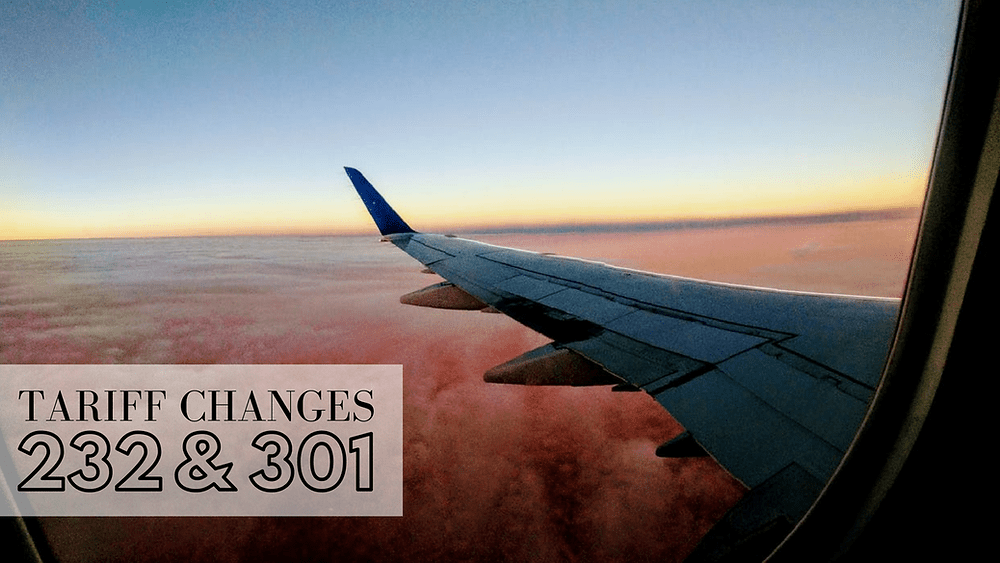
Here is a breakdown of what the tariff changes are going to look like for your business. In Section 301, this has been broken down into four parts. These are as follows:
- Parts 1& 2: This was the first $50 Billion in duties on products that fell under its tariff that were originally added up to 25%.
- Within part 2, there was an announcement for the ability to submit an Exclusion Request with an “undue burden” to attempt to forfeit the 25% tariff on these impose duties. This is a two minute plea to Customs and will be very hard to come by and rarely visited as a whole.
- Part 3: This was the next announced round of duties that will add an additional original 10% but will add up to the 25% as of January of 2019 for all products that fell under its tariff. This was the next $250 Billion in goods.
- Part 4: this is yet to be announced but it will include the last at least $250 Billion in tariffed goods.
Section 232 tariffs: on the other hand, are intended to limit the importation of any product which could result in a national security risk for the US. That is to say, these tariffs are designed to maintain the fitness of domestic producers who could be put out of business by foreign competition. President Trump is using this law to protect America’s steel and aluminum producers by imposing 25% and 10% section 232 tariffs on each of these industries respectively.
The effect of all new 232 or 301 tariffs will absolutely impede on many businesses by increasing their duties anywhere from an added 10% all the up to an 25% in duties being paid. This is an astronomical number for some businesses which is why completing a drawback program will be absolutely essential for many to complete.
If you have questions as to how to complete a drawback program around the new 301 issues, feel free to visit us here and send us a request to talk in greater detail.
#232tariffs #301tariffs
Frequently Asked Questions
No, and that difference matters more than the rate difference. CBP confirmed in CSMS 18-000419 that Section 301 duties are eligible for drawback at 99%. Section 232 duties were barred by the original steel and aluminum proclamations. Section 201 safeguard duties are eligible. Filing a claim that mixes these up creates a compliance problem, not just a smaller refund.
Partly. Proclamation 11021 and CBP guidance in CSMS 68253075, effective April 6, 2026, opened manufacturing drawback under 19 U.S.C. 1313(a) and (b) for steel, aluminum, and copper articles meeting the proclamation’s conditions. Unused merchandise and substitution drawback remain closed. The opening is narrow and turns on how the article was made, so scope has to be confirmed against your own HTS lines.
They stack, and recovery treats them separately. A Chinese steel derivative can pay ordinary duty, Section 301, and Section 232 on a single entry. The 301 portion is recoverable through standard drawback. The 232 portion is not, apart from the narrow manufacturing path. Claims have to identify each layer by its Chapter 99 HTS number alongside the Chapter 1 to 97 number.
Section 301 actions come from the U.S. Trade Representative after an investigation into another country’s trade practices, under the Trade Act of 1974. Section 232 actions follow a Commerce Department national security finding and are implemented by presidential proclamation, under the Trade Expansion Act of 1962. The 301 lists shift more often because they are tied to negotiation. Section 232 scope tends to grow through product inclusion rather than reset.
No. An exclusion stops the duty going forward and can support a refund on past entries, but that refund runs through a post summary correction or a protest depending on where the entry sits relative to liquidation. Drawback is a separate mechanism tied to export or destruction. One entry can qualify for one, both, or neither, and each path has its own deadline.
No. The 2018 actions covered steel and aluminum. Scope has since extended to copper, automobiles and parts, and additional categories, with derivative lists that keep growing. Importers who checked their 232 exposure once in 2018 and not since are often paying it on goods they do not think of as metal products.